

Uncovering a new form of companionship: An intimate view of Hwange National Park

Updated: Mar 2
There is an awakening that happens when you visit the Zimbabwean bush, and you don’t need any tools, any protocols or any instructions to follow for it to unfold. It happens just by arriving. Each sense, including your sixth, automatically reignites. They have no choice but to awaken, seduced by the landscape they find themselves in. Each part of Zimbabwe offers this opportunity, from standing on the edge of the Victoria Falls, to climbing the Chimanimani Mountains or paddling down the Zambezi River. Arriving in Hwange is no different.
Yet, it is different. A landscape so vast and fecund has to be different, as I would discover.
A first encounter
I first visited Hwange in my late twenties. It was a brief encounter. Too short to fully appreciate what I would later uncover. We were making our way from Victoria Falls to visit our cousin's farm just outside Bulawayo, a trip that would normally take four hours but was going to take twenty-four. The road, with its car-length and car-depth potholes, meant that an average speed of 40km/h was the only way to arrive with all four wheels still intact. For this reason, my mum had insisted we stop at Hwange Safari Lodge for a night. It was a beautifully situated hotel (still is) with a fabulous pool (still does), but our mode of transport and time pressures meant we weren't able to set out and explore as we would have liked. That would have to wait.
The second time, I arrived with my children. Phoenix was five and Wolfie four. My mum was working with Imvelo, an operator with several camps in the southernmost corner of Hwange National Park, and we had come to visit her. We made our way from Victoria Falls to Dete, where we boarded a little train known as the Elephant Express. What an extraordinary experience. For the next eighty kilometres I saw the wild through a child’s eye again. There were more 'look there's' and 'ooh, look at that' and 'did you see that?' than I had ever encountered. And it wasn't only the wildlife. It was the birds, the trees, the plants, the clouds.
We spent a few glorious days winding through camelthorn forests, sitting by waterholes, watching elephant, tracking lion, driving along grass vleis lined with palm trees, uncovering a magical corner of Zimbabwe. We finished our trip traversing the full length of the park on sand-filled roads, my mum in full adventure 4x4 mode — eight hours of driving through the bush. I was more alive than I had been in years.
Hwange gripped my heart, and had it pumping, vigorously.

A landscape like no other
Hwange National Park is Zimbabwe's largest national park. It sits at the northern edge of the Kalahari, a vast, ancient sandveld stretching across 14,651 square kilometres of wilderness. It forms part of KAZA — the Kavango-Zambezi Transfrontier Conservation Area — the largest transfrontier conservation area in the world, spanning five countries and almost 520,000 square kilometres of connected wild land. To stand inside it is to feel something of what the earth was before we divided it up.
Hwange is not one place. It is not one view, one smell, one sound. It is a multitude of all - shifting as you travel through it, from place to place, time of day to time of day, season to season. When you visit Hwange, you will smell the richness of the earth. You will taste it too. You will hear the rhythms of life and you will see what it is to be alive.
Drive into the teak forest: ancient, dense, dark, the bark warm ochre passing along your sides, bright evergreen leaves contrasting the deepest blue above your head, burnt reds and rust-orange soils beneath your feet. Then the forest opens without warning onto a vlei. A wide, breathtaking expanse of grassland, silver-gold in the afternoon light, the ‘lion’ grasses bending and whispering, hiding those within them. The rising dust bringing with it the smell of those who have passed over it.
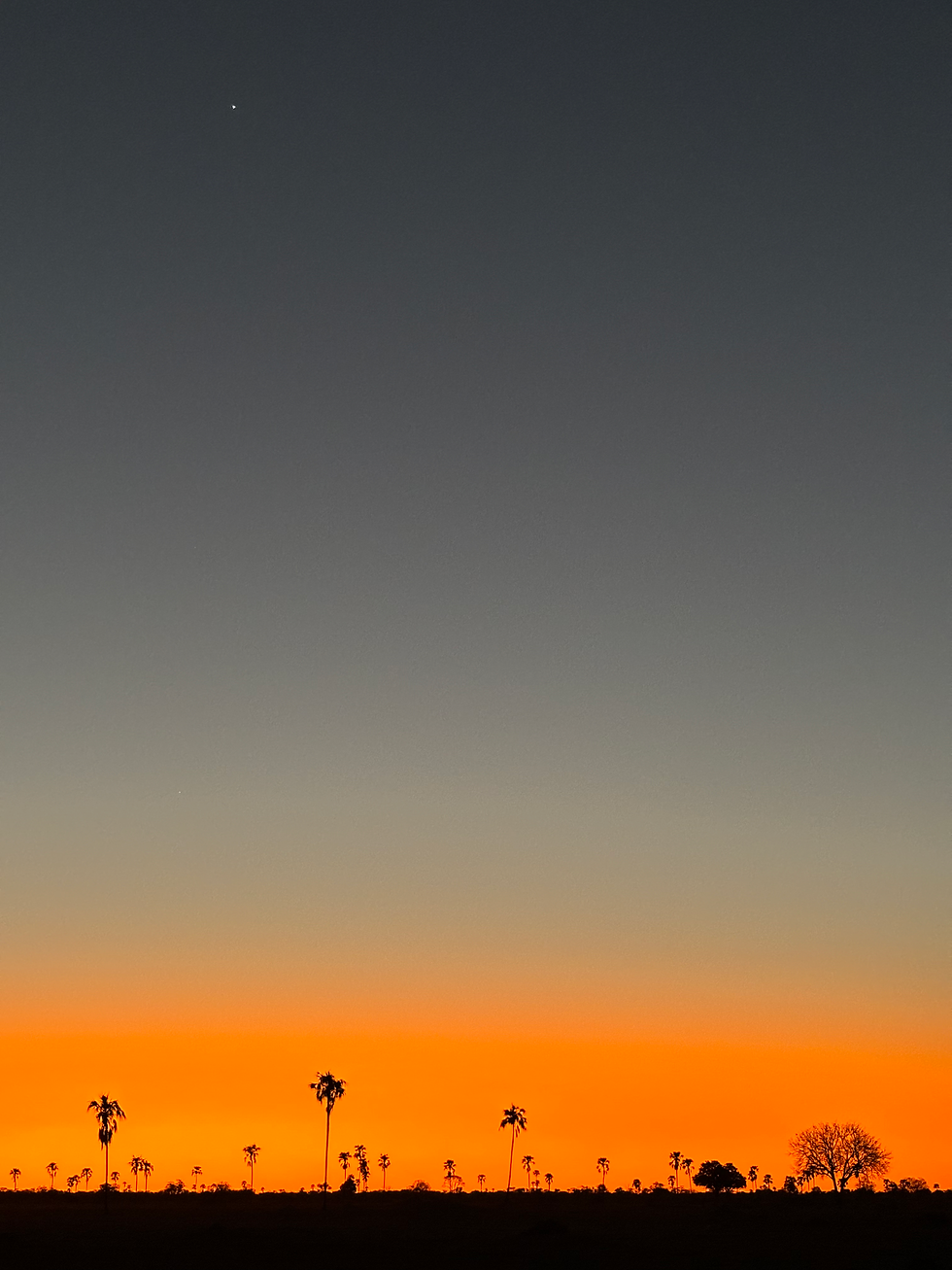
In the evenings, the sun streams through the canopies of the camelthorn trees in a cathedral-like vision. It is not a far stretch to imagine angels descending from the heavens. Towers of cumulus clouds gather on the horizon, rising forty thousand feet into the sky, with colours moving through them that the eye struggles to account for: amber, violet, deep rose, a burning orange that turns the entire landscape molten. You watch transfixed as it keeps changing, keeps offering something new, until the light is gone and the stars emerge in numbers too large to comprehend. The landscape changes again.
The feelings that accompany these wild visions are visceral. The landscape is porous — it breaches your body and takes hold. It is sensuality as we were meant to experience it.
But wait. There's more.
Hwange is home to some of Africa's largest elephant herds, as well as wild dog, lion, cheetah, leopard, giraffe, zebra, buffalo, hippo, wildebeest, roan and sable, to name a few. It holds over 400 species of birds. You will hear many before you see them: the fish eagle calling across water, the deep thrumming of the ground hornbill at dawn, the Pel's fishing owl at dusk, the laughing call of the green wood-hoopoe moving through the canopy, or the go-away bird, telling you - repeatedly - to go away.
There are termite mounds taller than a person, the quiet engineers of the ecosystem. There are dung beetles rolling their cargo with joyful efficiency. There are tracks on the ground pressed into the dust like signatures. Learning to read them, following their story slowly through the bush, connects you to this place in a way that sitting in a vehicle cannot quite replicate. You are tracking. You are attending. You are part of this system.
My own encounters with wildlife in Hwange have brought me to a new level of intimacy with the bush. From my first ever sighting of wild dog, watching them move through the teak forest with extraordinary stealth. To observing the matriarchal, deeply caring behaviours of elephants. Watching them wait patiently in the tree line until it is their turn to drink. Mothers and sisters closing rank, walking in sync around the babies among them. Then there is the hippo who has claimed his favourite waterhole, where he spends his days floating on his back, snorting at the animals who come to drink and the baboons roosting in the ilala palms above him.
Life unfolds as it is.
A returning gift
In 2024 I embarked on a new path, and that path led me back to Hwange. For some time I had been looking for ways to get closer to the problems I thought needed solving, and to find my way back to the bush. This led me to a role in conservation, one that would see me visiting the Hwange landscape regularly. And, in returning regularly, something happened that I had not anticipated.
It wasn't just that I felt at home. It was that I began to understand, slowly and in an embodied way, rather than intellectually, what it means to be in relationship with a wild place. Not a visitor. Not an observer, but part of. Knowing its rhythms, recognising its sounds, reading its moods. I found a new form of companionship. A companionship that stayed with me when I returned home. I found it in the birds, I found it in the trees, and in the landscape at home. Through this relationship, vitality arrived in abundance. And dare I say it, Love. In its primal form.
The experiences of awe and wonder I encountered whilst visiting Hwange continued to fuel a new desire: I wanted to bring others here. I wanted to bring women here. To have them feel what I had felt. Not to be told about it, not to read about it but to feel it in their own bodies, on their own skin, in their own lungs.
This is why we have chosen Hwange as one of our primary landscapes for our Women Wonder Wild adventures. It carries the very essence of what inspired our why.
To remember what it is to be wild.
To remember our relationship with it.
To remember the vivaciousness of life.
Women Wonder Wild creates encounters and experiences for women looking to return to the wild. Join us on an adventure in Hwange www.womenwonderwild.com.



Beautifully put, Deb, its all so true!