

The Birth of Women Wonder Wild

Updated: Feb 6
A brief peregrination back in time
The origin story of Women Wonder Wild is a peregrination of sorts, and to share only part of the story would be an injustice to the journey many of us, as women, travel. We don't simply arrive somewhere suddenly. Our lives are made up of interwoven moments, each thread carrying reflection, lesson, discovery, and meaning. So I hope you'll indulge me as I share my wider story, to honour what came before, because every step I took, every role I inhabited, and every skill I learned shaped the ground from which Women Wonder Wild has emerged.
Living the Dream (Or So I Thought)
I was born and raised in Zimbabwe, where I spent an inordinate amount of my early childhood outside and largely unsupervised. I climbed avocado trees barefoot, scrambled up kopjes, slept under the stars, jumped off runaway horses, searched for tortoises, and fished along riverbanks. For all intents and purposes, I was a wild child.
Yet at the same time, I attended an all-girls school and grew up in a house where my mother was single-handedly raising four children while building and running companies and living a life of Riley. She was the epitome of a strong, independent woman, and she preached what she practised. I witnessed and absorbed the sermon: as women, the world was now our oyster. With enough effort and determination, we could be anything, do anything, and achieve anything. We could have it all.
It was an incredibly empowering message. The disclaimer about losing yourself to get there, however, was written in very fine print.
At eighteen, I took this message with me when I left school and Zimbabwe to move to Europe. My twenties were busy: moving countries, painting a colourful career, ignoring ceilings, and striving for titles and status. I believed I understood how the world worked and how to succeed within it. I didn't question the game; I simply learned to play it well.
There was courage, competence, and adaptability in those years. I became excellent at being who the world needed me to be. The wild child? She went quiet.
Cracks in the Edifice
My thirties were tumultuous but rewarding. Change was the name of the game. I moved back to Africa. With a marriage, two beautiful children, a conscious uncoupling, a couple of serious burnouts and some therapy, the door to self-enquiry cracked open. It opened just enough to feel the scratching within, but not enough to name what that itch might be.
It did, however, begin to shift my attention. I became more intentional in my work, drawn toward organisations that measured impact over profit. I learned how to operate in complex systems, how to be accountable, to stand my ground, and to lead. The activist in me began to surface. I was still striving, still chasing, but with a growing sense of what I valued.
Then I turned forty. Perimenopause arrived. A global pandemic ensued. And the door to self-enquiry didn't just open, it blew wide open.
A Cosmic Tap on the Shoulder
As though a global pandemic wasn't enough, many women of my generation found themselves navigating perimenopause at the same time. Two threshold events collided: a global confrontation with mortality, and a deeply personal reckoning within our own bodies and minds.
For me, this was the catalyst for a midlife awakening.
I realised I had been living in overdrive, disconnected from my body and disconnected from myself. But more than that, I had been living in constant comparison. Comparing myself to other women, to earlier versions of myself, to some imagined future self who had it all figured out. The exhaustion wasn't just physical. It was existential.
When the world slowed down, and my body insisted that I do the same, there was finally time to reflect. Time to listen. Time to feel. Time to ask questions I had been too busy to ask before, including the biggest one of all: Who am I… really?
Once I began to question, the floodgates opened and realisations came one after the other. At first, I felt completely disillusioned. It certainly looked more like a midlife crisis than a midlife awakening.
Then, a wild yearning set in.
Coming Home to the Wild
I began to crave things. Stories, poetry, and beautiful books. I wanted to learn about myth and history, culture and consciousness. I studied coaching and anthropology, the cosmos and spiritual ecology. I connected with my body and my senses. I worked with my hands, in the garden and with clay. I spent wondrous hours crying and laughing in the company of other courageous women navigating similar terrain, sometimes holding space and sometimes just bearing witness to their journey.
And I began to spend time in nature again.
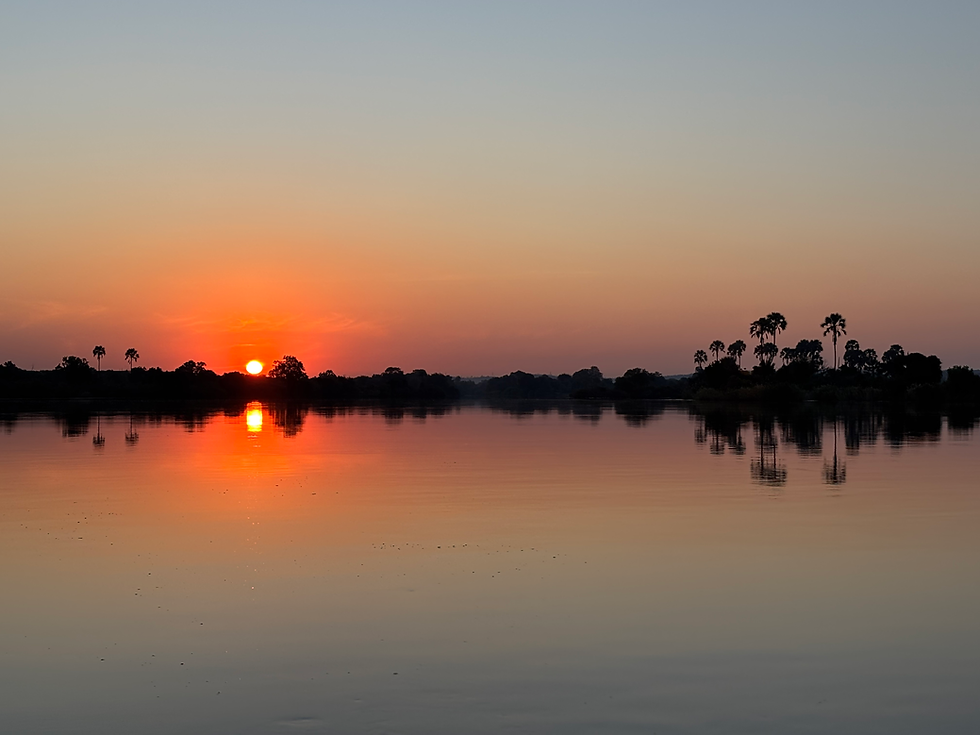
It became a necessity for me to spend time in nature, whether in my garden, up a mountain, or by the sea. While all these spaces kept me centered, it wasn't until I returned to the bush in Zimbabwe that this primal feeling of belonging returned.
Something extraordinary happened without effort. The instinct to slow down and pay attention kicked in, as did the quiet adrenaline of being alive. I was humbled. In fact, I disappeared. The constant internal commentary quietened. The need to fix, to do, to question, to answer, fell away. An intuitive knowing arrived instead.
The wild child returned. I was home.
Women Wonder Wild Arrives
And so, Women Wonder Wild was born. It arrived through the integration of my journey, weaving together everything it has given me: the capacity to hold complexity, the ability to walk alongside others at moments of transition, and the deep, instinctive knowing that nature and community are not luxuries for women in midlife. They are essential.
This work is also born from something I witnessed again and again: how powerfully women change when we step out of comparison and into relationship. Relationship with ourselves, with one another, with the living world. When we stop performing and start belonging, balance is inevitably restored.
Women Wonder Wild is an invitation for women in midlife to embark on an adventure. To step into awe, wonder, reverence, and connection. When we experience these things not intellectually but in the body, it changes how we live. It changes how we relate. It changes what we value.
This is a beautiful form of activism. For when women reconnect with the living world and with one another, we naturally begin to re-orient ourselves. We stop striving to be better than, different from, or ahead of. We start simply being part of. And from that place, balance is restored.
If this resonates with you, I would be honoured to bring you wandering with us on a wild adventure.



Comments